
Zinc: The Quiet Mineral That Matters for Your Skin
We rarely think about zinc when we talk about beauty. Yet your skin uses it every day to keep its cells functioning, renew itself, and participate in its natural repair mechanisms.
Zinc is less famous than collagen, hyaluronic acid, or vitamin C. Yet this small mineral plays a very real role behind the scenes of your skin.

Zinc Is Not a «Beauty Supplement»
It would be easy to tell a story that is too simple.
Your skin looks less healthy.
You take zinc.
And your skin regains its glow.
But biology does not work like an advertisement.
Zinc is an essential trace mineral. Your body needs it in small amounts, but it is involved in a large number of cellular processes.
And your skin is particularly concerned.
It renews itself continuously. Its cells divide, produce proteins, communicate with one another, and participate in maintaining the skin barrier.
Zinc is involved in several of the mechanisms that allow these cells to function normally.
So it is not a beauty ingredient in the traditional sense.
It is more like a small piece of the invisible machinery behind what you see in the mirror.
Your skin does not need zinc because it is «trendy». It needs it because its cells are constantly at work.
That is the difference between an essential nutrient and a marketing argument: zinc contributes to normal body function, but that does not mean that taking more of it will automatically make your skin look better.
Why Does Zinc Matter So Much to the Skin?
There is something fascinating about skin: it never stays exactly the same.
Old cells disappear.
New cells take their place.
The skin barrier is continuously maintained.
And when the skin is stressed or damaged, a whole series of mechanisms gets to work to participate in its repair.
Zinc is involved in some of these cellular functions.
Zinc-dependent enzymes and proteins participate in processes related to tissue renewal.
This is one of the reasons zinc appears in research on wound healing and skin repair.
That does not mean that someone with dry or dull skin necessarily has a zinc deficiency.
It simply means that when we look at how skin functions, zinc is one of the elements the body uses.
And that distinction matters.
Your Skin Is a Permanent Construction Site

Imagine your skin as a construction site that never closes.
Some cells have to be replaced.
Existing structures have to be maintained.
New proteins have to be produced.
The barrier has to be maintained.
The skin has to respond to external stressors.
And sometimes damage has to be repaired.
All of this happens without you having to think about it.
You do not give your skin any instructions in the morning.
Yet it keeps working.
Zinc is one of the many micronutrients that contribute to this biological activity.
It is not spectacular.
It is not instantaneous.
But that is precisely what makes it interesting.
Zinc Starts With What Is on Your Plate
Before thinking about capsules, there is a much simpler question:
What do I regularly eat?
Zinc occurs naturally in many foods.
Oysters and some other seafood are particularly rich in it. Meat and poultry also provide zinc. It is also found in dairy products, eggs, legumes, nuts, seeds, and some whole grains.

Plant sources, however, have an interesting characteristic.
Some plant foods contain phytates, compounds that can reduce zinc absorption.
That does not mean plant-based zinc «does not count».
It simply means that the amount present in a food and the amount actually absorbed by the body are not exactly the same thing.
This is a detail that rarely comes up in beauty discussions.
And yet it changes the way we look at nutrition.
A varied diet therefore provides zinc from different foods and in different forms.
Seafood.
Meat or poultry.
Eggs and dairy products.
Legumes.
Nuts and seeds.
Whole grains.
There is no need to turn your diet into a constant calculation.
The idea is rather to understand that micronutrients generally arrive as part of a whole.
Your body does not receive «zinc for the skin» on one side, «magnesium for the muscles» on another, and «vitamins for everything else».
It receives food.
And it uses what that food provides according to its needs.
Nutrition is not a collection of separate drawers: your body uses the nutrients your diet provides together.
The «I Need Zinc» Trap
Zinc has also developed a reputation that deserves to be viewed with a little perspective.
Problem skin?
Zinc.
Hair looking less healthy?
Zinc.
Fatigue?
Zinc.
Immunity?
Zinc.
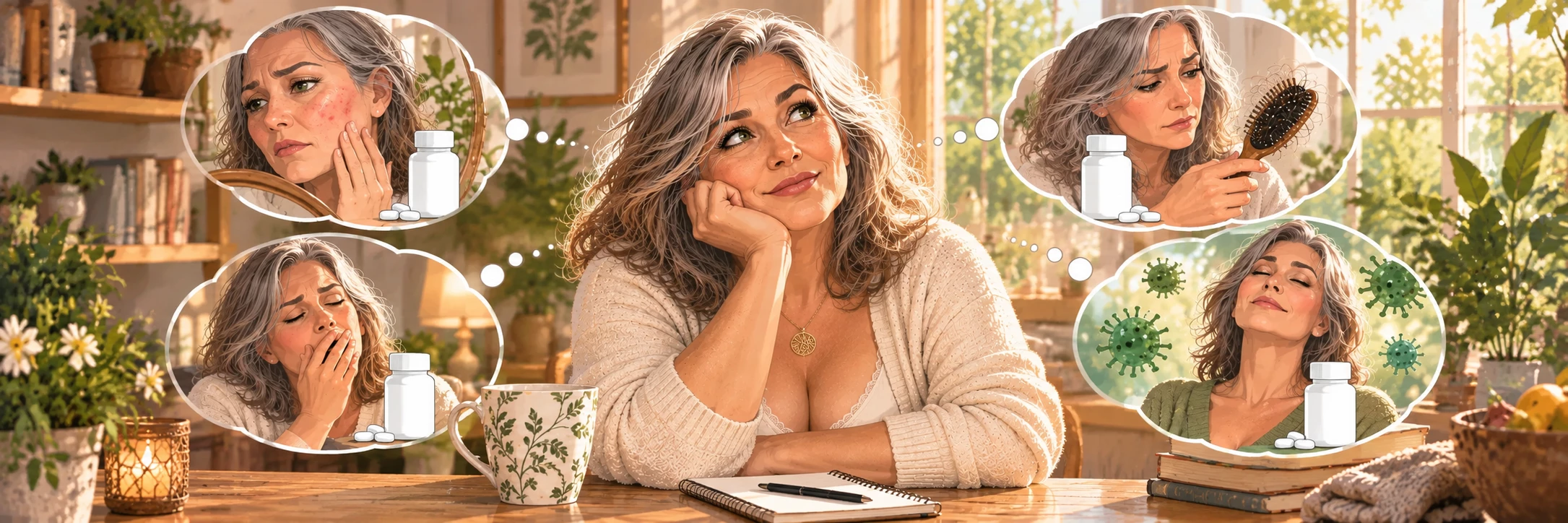
When we connect everything to the same mineral, we eventually make it say much more than it can actually say.
Dry skin does not allow us to conclude that there is a zinc deficiency.
Neither does dull skin.
And a few blemishes certainly do not constitute a nutritional test.
A true zinc deficiency can affect different tissues and functions of the body, but it cannot simply be determined by looking at your face in the mirror.
That is precisely why it is better to think of zinc as one piece of the nutritional machinery rather than as an automatic answer to a skin problem.
What If You See Zinc in a Skincare Product?
Here is another interesting part of the story.
Zinc is not found only in food or supplements.
It is also present in products designed to be applied to the skin.
Zinc oxide, for example, is used in different topical formulations.
It can be found in some mineral sunscreens, but also in products designed to protect or soothe the skin.
And here, an important distinction needs to be made.
The zinc your body obtains from food and a zinc compound applied to the skin do not necessarily play the same role.
They are not simply two different ways of taking «the same thing».
The formulation, concentration, how the product is used, and its intended purpose all matter.
This is exactly the kind of detail that allows you to look at a label differently.
Supplement, Food, or Skincare: Three Different Stories
When you see the word «zinc» on a product, do not automatically assume that it means the same thing.
In a food, zinc is part of the nutritional whole you consume.
In a supplement, it is provided in a specific form and amount.
In a cosmetic product, a zinc-containing compound may have a function related to the product's local use.
Three contexts.
Three purposes.
And sometimes three completely different ways of using the same word on a label.
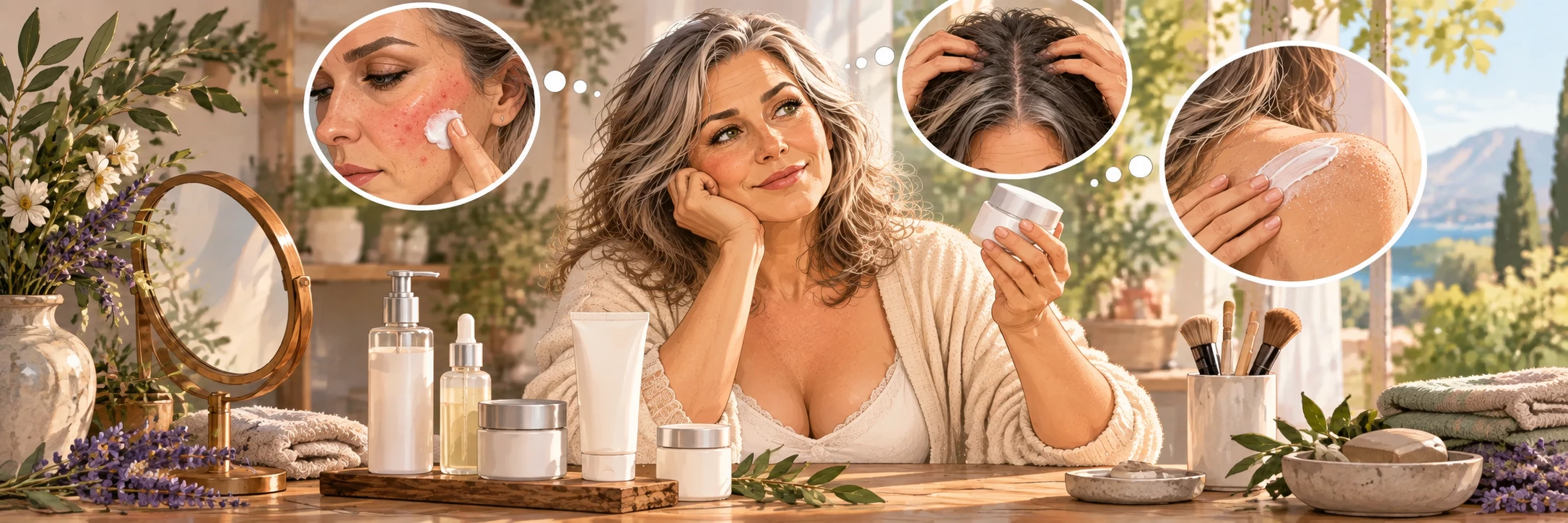
This is particularly useful to know when you start comparing products.
The name of an ingredient is not always enough to understand what a product actually does.
You need to look at its form, its concentration when stated, its formulation, and especially the purpose for which it is intended.
What About Zinc Supplements?
This is where caution becomes interesting again.
Zinc is essential.
But that does not mean that everyone benefits from taking more of it.
As with magnesium, «more» does not automatically mean «better».
Excessive zinc intake, particularly from supplements, can disrupt the balance of other nutrients. Very high amounts taken over time can, in particular, reduce copper absorption.
The goal is therefore not to turn an essential nutrient into a universal treatment.
If your diet already provides enough zinc, routinely adding a supplement simply in the hope of improving the appearance of your skin is not a conclusion that can be drawn simply from the presence of zinc in the body.
And when a supplement is being considered on a regular basis, particularly in the presence of medications or a health condition, asking a healthcare professional for advice is a good way to check whether supplementation actually makes sense.
Zinc is essential in small amounts. That does not mean your skin needs an extra dose every time it looks less radiant.
What Zinc Really Teaches Us About Your Skin

Zinc ultimately brings us back to the same discovery as magnesium.
Your skin is not a surface independent from the rest of your body.
It is alive.
It renews itself.
It reacts.
It protects itself.
It repairs itself.
And all of this work depends on a multitude of invisible resources.
Zinc is only one piece among many.
But it is an interesting piece because it forces us to look beyond the jar of cream.
When you choose a skincare product, you can ask yourself what it brings to the surface of your skin.
When you look at your diet, you can ask yourself what it brings to your body as a whole.
The two questions are different.
And both can be relevant.
So, Should You Buy a Zinc Product?
Not simply because it has the word «zinc» on it.
That may be the best conclusion to draw.
A good choice starts with a simple question:
What exactly am I looking for?
A food rich in zinc?
A supplement?
A skincare product containing zinc oxide?
A product intended for a specific protective or skin-comfort function?
The answer will not be the same.
And that is precisely what allows you to make smarter choices.
Instead of looking for the product that contains «the best ingredient», you can start by looking at the product as a whole.
Its formulation.
Its use.
Its claims.
And the place it can realistically have in your routine.
Understanding an ingredient does not mean you have to buy it. It means knowing why it is there, what it may contribute, and what you should not expect from it.
After Zinc, Let's Look Even Further
Magnesium taught us that the skin also depends on what happens inside the body.
Zinc shows us something more.
The same mineral can exist in our food, in a supplement, or in a skincare product without necessarily having exactly the same function in each context.
It is a simple distinction.
But it can greatly change the way we read labels and choose our products.
And above all, it reminds us of one thing:
Your skin does not need you to buy everything that carries the word «skin».
It needs you to gradually understand what may actually be useful to it.
The more you understand what is happening behind your skin, the less you need to choose your skincare products at random.
MEDICAL DISCLAIMER: SZ provides general information for educational purposes. It does not replace the advice, diagnosis, or treatment of a qualified healthcare professional. SZ does not diagnose, treat, cure, or prevent disease. For health-related decisions, consult a qualified professional.
Disclosure: Some links may be partner links. SZ may receive a commission from Canadian companies on qualifying purchases, at no extra cost to you and without influence on our editorial content.