
Understanding Your Menopause: What Is Really Happening Inside Your Body
For a long time, menopause has been described as a list of things that may happen: hot flashes, disrupted sleep, weight gain, drier skin, muscle loss, weaker bones. The list is accurate. But it does not really help us understand what is happening. Because the most interesting thing is not that several things change. It is why they can change at the same time. Menopause does not simply take one hormone away from the body. It gradually changes the signals that several of its systems had become accustomed to responding to. And one of the main players in this story is estradiol. Estrogens are often discussed as though they were simply hormones related to menstruation and reproduction. Yet, estradiol acts in many different tissues. It plays a role in regulating temperature, energy, metabolism, muscles, bones, blood vessels, adipose tissue, and the brain. When its levels change, an entire network therefore has to adapt. This is probably one of the keys to understanding menopause: your body is not breaking down. It is functioning in a new hormonal environment.

One Hormone Can Have Far More Jobs Than You Might Think
A hormone is a chemical messenger. It is produced somewhere in the body, enters the bloodstream, and can transmit information to cells located far from where it was produced. But not every cell responds to every message. To respond to estradiol, a cell must, among other things, have receptors capable of recognizing that signal. These receptors are found in different tissues, which helps explain why a hormonal change can have such diverse effects. It is a little like sending the same message to several departments within the same organization. The department responsible for temperature regulation will not react in the same way as the one involved in bone remodeling. Muscle will not react in the same way as adipose tissue. Skin will not react in the same way as blood vessels. But all of them receive information from the same overall change. This also explains why it can be difficult to answer a question such as: “Is it menopause, or simply aging?”
The two processes can happen at the same time. Research on body composition also shows that the mechanisms are complex. Menopause is associated with an increase in fat mass and a redistribution toward the abdominal region, as well as changes in muscle mass and strength, but the exact contributions of menopause, aging, energy balance, and lifestyle remain difficult to separate. This uncertainty is not a flaw in science. It is important information. It means we should be cautious about explanations claiming that every change after age 45 is caused by one single thing.

A Hot Flash Begins in the Brain
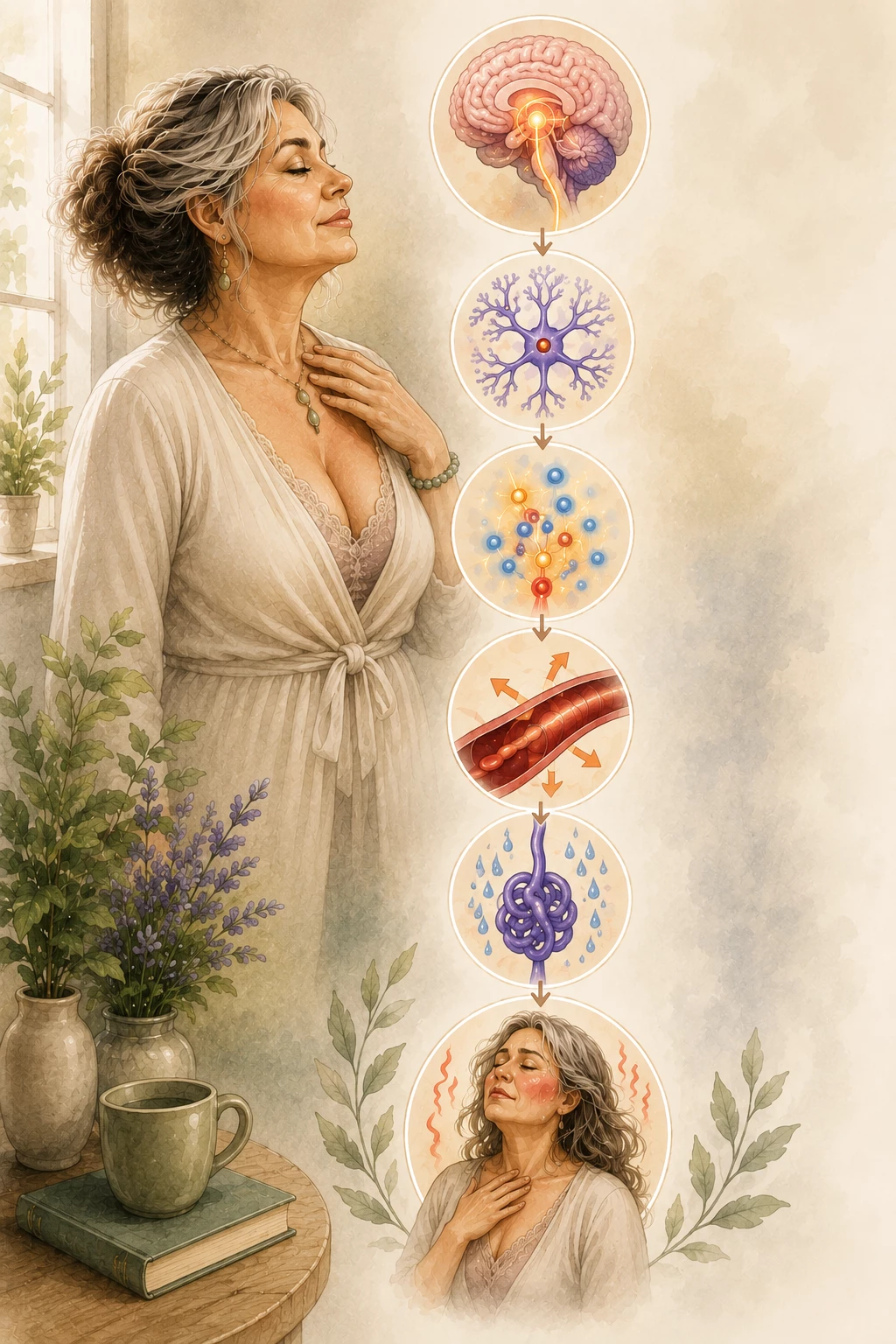
Here is a particularly revealing example. A hot flash makes it feel as though your body suddenly becomes too hot. Yet the problem is not simply that the outside temperature is too high. Your brain contains a small region called the hypothalamus. Located at the base of the brain, this region plays a role in controlling body temperature, hunger, thirst, and several hormonal functions. It can be thought of as one of the body's control centers. To keep your temperature within a relatively stable range, the body has mechanisms that can either retain or release heat. When you need to lose heat, blood vessels close to the skin can dilate and sweat glands can produce sweat. During the menopausal transition, declining estradiol levels alter the activity of a group of neurons in the hypothalamus known as KNDy neurons. These neurons become more active when the estradiol signal decreases and can then stimulate the circuits that trigger heat dissipation. This contributes to the flushing, sensation of heat, and sweating characteristic of hot flashes. This allows us to look at a hot flash differently. It is not simply your body producing too much heat. It is also your temperature-regulation system becoming more likely to trigger a cooling response. And this understanding is not merely theoretical. It helps explain why newer treatments specifically target some of the messengers used by these neurons rather than simply replacing hormones.
Adipose Tissue Is More Than Just a Fat Reserve
Here is another idea worth knowing. We tend to think of adipose tissue as an energy reserve: the body stores what it does not immediately need. That is true. But it is far from the whole story. Adipose tissue is also an endocrine organ. This means that it produces and releases substances capable of communicating with other parts of the body. And there is an even less familiar feature. After menopause, adipose tissue becomes an important source of circulating estrogens. It can convert certain hormonal precursors into estrogens through an enzyme called aromatase. This obviously does not mean that adipose tissue “replaces” the ovaries. It does not. But it shows that the hormonal system does not simply stop when the ovaries gradually stop producing their own estradiol. The body reorganizes its sources and its exchanges. And this helps explain why the relationship between adipose tissue and hormones is much more complex than the simple calculation of “calories in versus calories out.”

This is also why you should be
cautious with statements such as:
“Menopause makes you gain weight.”
The reality is more subtle. The menopausal transition is associated with changes in fat distribution, including more fat around the abdominal organs, but the mechanisms are multiple and are not yet completely disentangled. Your body does not suddenly decide to “store fat because it is aging.” It is going through a profound change in its hormonal and metabolic environment.
Muscle and Bone Are Not Two Separate Stories
Muscle is often presented as something we need to preserve in order to stay strong. That is true. But its importance goes much further. Muscle is a metabolically active tissue. It uses energy, responds to different hormonal signals, and communicates with other tissues. Recent research even shows that muscle has its own mechanisms for locally producing estrogens from precursors. The importance of these locally produced estrogens is still being investigated, but it reinforces an important idea: muscle is not simply a tissue that “undergoes” menopause. It also participates in the body's adaptation. And it has a close relationship with bone. Bone is alive. It is continuously broken down and rebuilt by different cells. This process, known as bone remodeling, allows the skeleton to adapt and repair itself. Muscle and bone also communicate through mechanical and chemical signals. When you use your muscles, you place forces on your skeleton. These forces contribute to signals that help bone maintain its structure. This means that movement is not simply a way to “burn calories.” Your body also receives information from what you ask it to do.

This is a particularly interesting idea after age 45. If the body regularly receives the message, “This muscle tissue is necessary,” it has a reason to maintain it. If the skeleton regularly receives the mechanical stresses associated with movement and weight-bearing, it also receives signals that support its maintenance. This does not mean that exercise can cancel out the effects of menopause. It means that exercise can become a tool that helps the body adapt more effectively to this new stage. Recent evidence also shows that the menopausal transition is a particularly important period for changes in muscle and bone mass, and that different types of exercise can help maintain them.
Blood Vessels Change Their Context Too
There is another change that is discussed far less often when menopause is mentioned: the cardiovascular system. Before menopause, women generally have a lower cardiovascular risk than men of the same age. This difference decreases with age and around the menopausal transition. Estradiol acts, among other things, on blood vessels and on the cells lining their interior, known as endothelial cells. The endothelium is a thin layer of cells forming the inner lining of blood vessels. It is not simply a passive coating: it participates in regulating vessel diameter, blood flow, and several mechanisms involved in cardiovascular health. When the estrogen signal decreases, vascular physiology can also change. Recent research highlights changes in blood pressure, blood lipids, insulin sensitivity, and vascular function around the menopausal transition. This is another reason not to reduce menopause to what you see in the mirror. A woman may feel perfectly well while going through biological changes that deserve to be taken seriously. And this is precisely where knowledge becomes useful. Understanding your body does not mean worrying about everything. It means knowing where to focus your attention.
So, what is really changing?
The answer is not: “Your body is deteriorating.”
Nor is it: “Everything is caused by hormones.”
The reality is more interesting. As ovarian production of estradiol decreases, several systems in the body evolve within a new hormonal environment. The brain adjusts some of its mechanisms. Thermoregulation can become more sensitive. Adipose tissue changes its behavior and distribution. Muscle and bone evolve together. Blood vessels function within a different context. And the skin, too, receives different signals. All of this happens at the same time as another phenomenon that cannot be completely separated from menopause: normal aging. This is why there is no single magical explanation. And it is also why there is no single magical solution.
Your Body Does Not Need to Become What It Was at 30
This may be the most important conclusion. Your 50-year-old body is not a 30-year-old body that has failed. It is an organism functioning at another stage of life. That does not mean you have to accept everything without doing anything. It means our goals can change. Instead of asking, “How can I make my body go back to the way it was?” we can ask a much more useful question: “How can I help my body live well at the stage it is in?”
This question opens the door to another way of taking care of yourself. You can aim to preserve your strength rather than trying to regain a past silhouette. To protect your bones rather than waiting for them to become fragile. To understand your skin rather than multiplying products to fight the signs of aging. To monitor your cardiovascular health rather than waiting for a problem to appear. To understand your sleep rather than considering every bad night simply another side effect of age. Menopause is therefore not simply a period during which certain things disappear. It is a period during which the operating rules of your body change. And the more you understand these new rules, the more possible it becomes to work with your body rather than against it. Perhaps that, ultimately, is what it means to understand your menopause.
MEDICAL DISCLAIMER: SZ provides general information for educational purposes. It does not replace the advice, diagnosis, or treatment of a qualified healthcare professional. SZ does not diagnose, treat, cure, or prevent disease. For health-related decisions, consult a qualified professional.
Disclosure: Some links may be partner links. SZ may receive a commission from Canadian companies on qualifying purchases, at no extra cost to you and without influence on our editorial content.