
The Skin Barrier: The Living Wall of Your Skin
Introduction — A Much More Intelligent Boundary Than It Seems

We hear a lot about the skin barrier.
A cream "repairs the barrier."
Ceramides "strengthen the barrier."
Cold weather "weakens the barrier."
But what exactly are we talking about?
The skin barrier is not simply a thin film sitting on your skin like plastic wrap.
It is a complex system that helps retain water, limits the penetration of certain unwanted substances, and contributes to the body’s defense mechanisms.
And something rather fascinating is found at its surface:
the microbiome.
These two systems therefore do not function entirely separately.
The barrier creates an environment in which microorganisms can live.
And the microorganisms present on the skin, in turn, interact with skin cells and with the skin’s defense mechanisms.
In other words:
Your skin does not simply have a barrier. It has a living environment that contributes to its balance.

The Skin Barrier: A Wall That Still Lets Certain Things Through
To understand this relationship, let’s imagine the outermost layer of the skin.
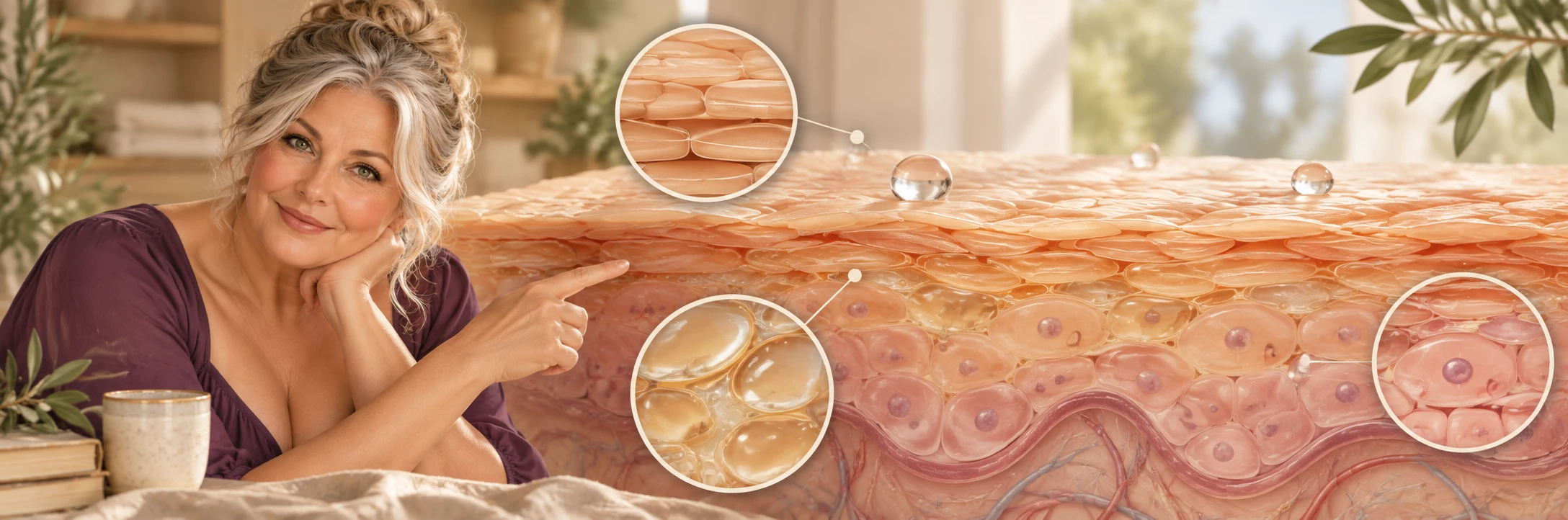
The epidermis contains cells called corneocytes, surrounded by various lipid substances.
A very useful image is sometimes used to explain this organization:
bricks and mortar.
The corneocytes are, in a sense, the bricks.
The lipids surrounding them — particularly ceramides, cholesterol, and fatty acids — contribute to the role of the "mortar."
This organization helps limit excessive water loss and protects the tissues beneath the surface.
But there is an important point to remember: an effective skin barrier is not a completely airtight barrier.
It must also allow certain exchanges with the environment.
The skin exchanges water and heat with its surroundings, among other things.
A good barrier is therefore selective, not simply closed.
When the Barrier Becomes Weakened, Water Escapes More Easily
One of the important functions of the skin barrier is to limit transepidermal water loss, meaning the water that continuously evaporates through the skin.
When the barrier is functioning properly, this loss remains relatively controlled.
When it is compromised, water can escape more easily.
This is one of the reasons why skin with a disrupted barrier can become:
- dry;
- rough;
- uncomfortable;
- more sensitive;
- sometimes more reactive.
And here is an interesting detail:
dehydrated skin is not necessarily skin that simply lacks water.
The problem may also be that it is less able to retain the water it already contains.
This is an important distinction.
Hydrating the skin and improving its ability to retain that hydration are related, but they are not the same thing.
The Microbiome Enters the Equation
Let’s return to our community of microorganisms.
The microorganisms present on the skin live in the conditions created by the skin itself: pH, sebum, humidity, temperature, availability of certain nutrients, and so on.
When these conditions change, their environment changes as well.
A significant change in the barrier can therefore be accompanied by changes in the microbiome.

But the relationship also works in the other direction.
The microorganisms present on the skin produce various molecules and interact with skin cells and the immune system.
Some of these interactions may contribute to maintaining the skin environment.
This is why researchers increasingly talk about a bidirectional relationship between the skin barrier and the microbiome.
It is not simply:
barrier → microbiome
or
microbiome → barrier
It is rather:
barrier ↔ microbiome.
The Famous pH: A Small Detail With Great Importance
We have already encountered pH in previous articles.
Here, it takes on even more meaning.
The surface of the skin is generally slightly acidic. This acidity contributes to several skin functions, including the activity of certain enzymes involved in the formation and maintenance of the barrier.
It also helps create a particular environment for microorganisms.
This explains why a significant and repeated change in pH may not be entirely harmless.
And it helps us understand something very simple:
A product does not have to "kill the good bacteria" to indirectly alter the microbiome’s environment.
It may be enough for it to permanently change the conditions in which the microbiome evolves.
This is much more subtle than the familiar scenario:
"product → bacteria destroyed → microbiome damaged."
Reality looks more like:
"product → skin environment altered → living conditions changed → microbiome may evolve."
Why Compromised Skin Can Become More Reactive
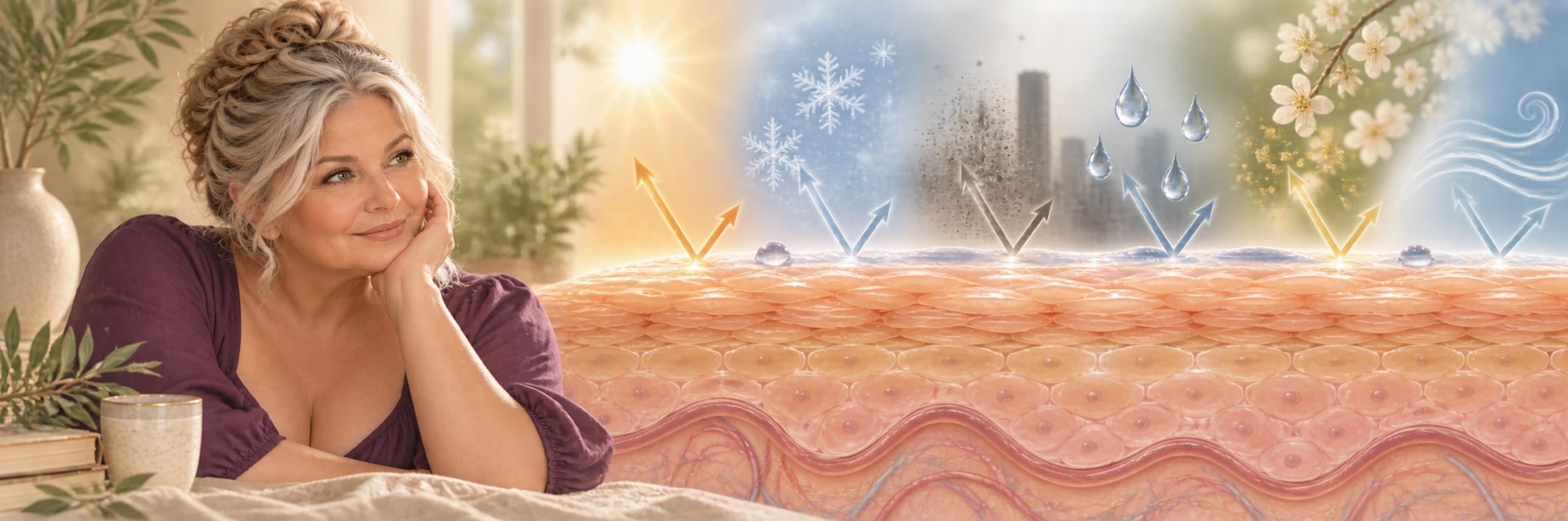
When the skin barrier is disrupted, certain substances from the environment can penetrate more easily into the superficial layers of the skin.
At the same time, the skin’s defense mechanisms may be called upon more heavily.
This is one of the reasons why skin with a weakened barrier can become more sensitive to different factors: cold, wind, irritating products, or certain cosmetics.
The microbiome is part of this equation, but it should not be blamed for every problem.
Reactive skin is not automatically a sign of a "bad microbiome."
Many factors can be involved.
This is precisely why we should be cautious about simplistic diagnoses based on a single factor.
What You Can Take Away
The skin barrier is not simply an impermeable layer.
It is a complex system that helps limit water loss and contributes to the protection of the body.
The microbiome and the barrier are connected.
The skin’s conditions influence the microbiome, while microorganisms interact with skin cells.
pH matters.
The skin’s surface is naturally acidic, and this environment contributes to the skin’s normal functioning.
Reactive skin does not necessarily mean that its microbiome is "bad."
Many factors can explain a skin reaction.
And above all:
The skin barrier is not an inert wall. It is a living boundary, constantly interacting with its environment.
We now know what this barrier is and why it has such a close relationship with the microbiome.
But one very practical question remains: what happens when we try to "help" our skin even more?
More products, more exfoliation, more active ingredients, more treatments…
At what point can trying to take better care of our skin become counterproductive?
MEDICAL DISCLAIMER: SZ provides general information for educational purposes. It does not replace the advice, diagnosis, or treatment of a qualified healthcare professional. SZ does not diagnose, treat, cure, or prevent disease. For health-related decisions, consult a qualified professional.
Disclosure: Some links may be partner links. SZ may receive a commission from Canadian companies on qualifying purchases, at no extra cost to you and without influence on our editorial content.