
Does Your Skin Have a Biological Clock?
You may already have noticed that your skin does not always seem to be the same.
In the morning, it may look a little puffy.
During the day, it may become shinier, drier, or more sensitive.
In the evening, some sensations may change again.
And at night, while you sleep, your skin continues to function.
Your skin therefore does not live in exactly the same way at every hour of the day.
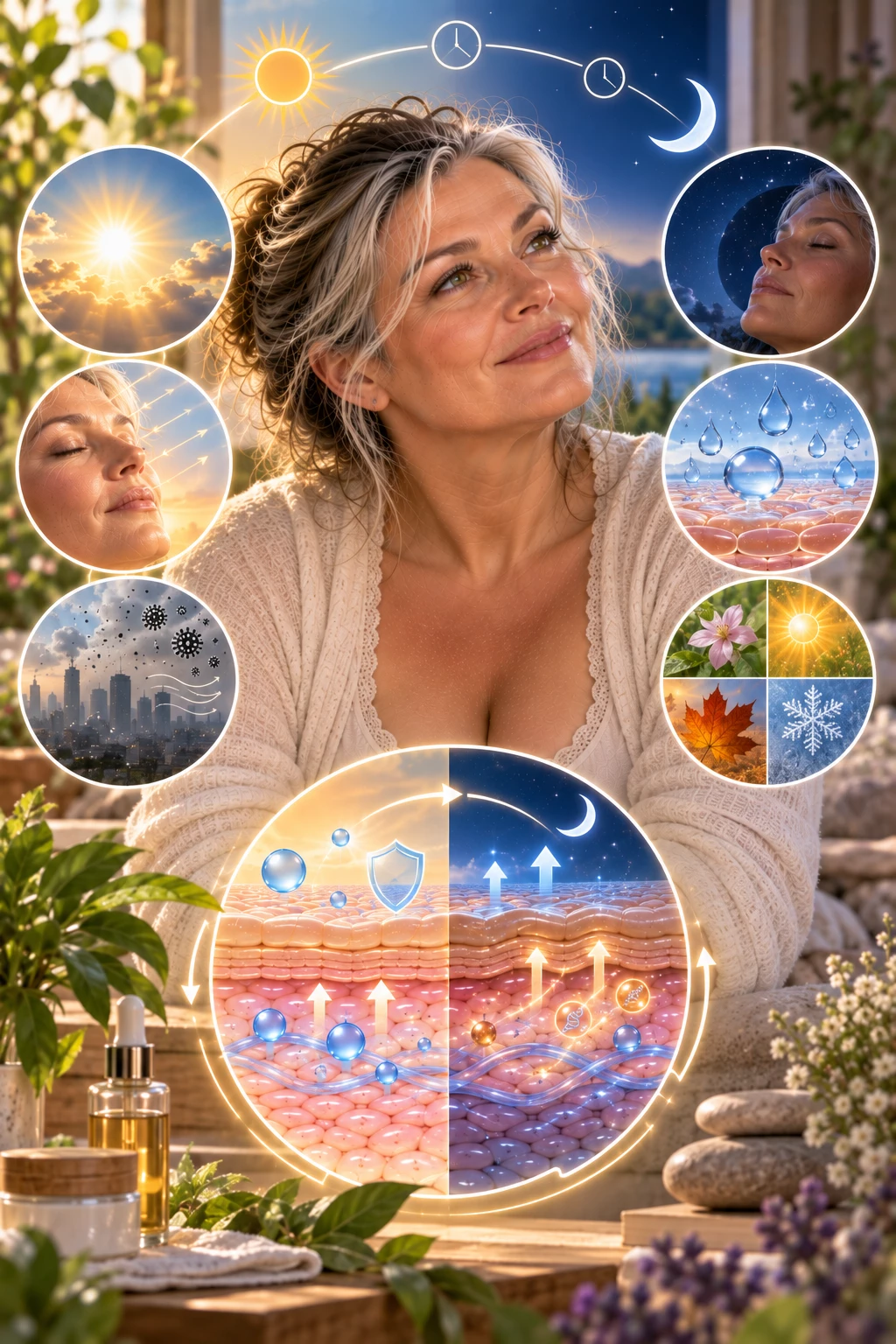
The skin has biological rhythms that are linked in particular to the sleep-wake cycle and the alternation between light and darkness. It also has peripheral cellular clocks.

A clock… but not a little watch hidden under your skin
When we say that the skin has a "biological clock," we obviously should not imagine a miniature mechanism counting the hours.
It is a much more subtle biological system.
Our body has a central circadian clock that helps synchronize many functions over a cycle of about twenty-four hours.
But this central clock is not alone.
Biological clocks also exist in different tissues.
And the skin has one.
Some of its cells can therefore follow biological rhythms that vary throughout the day.
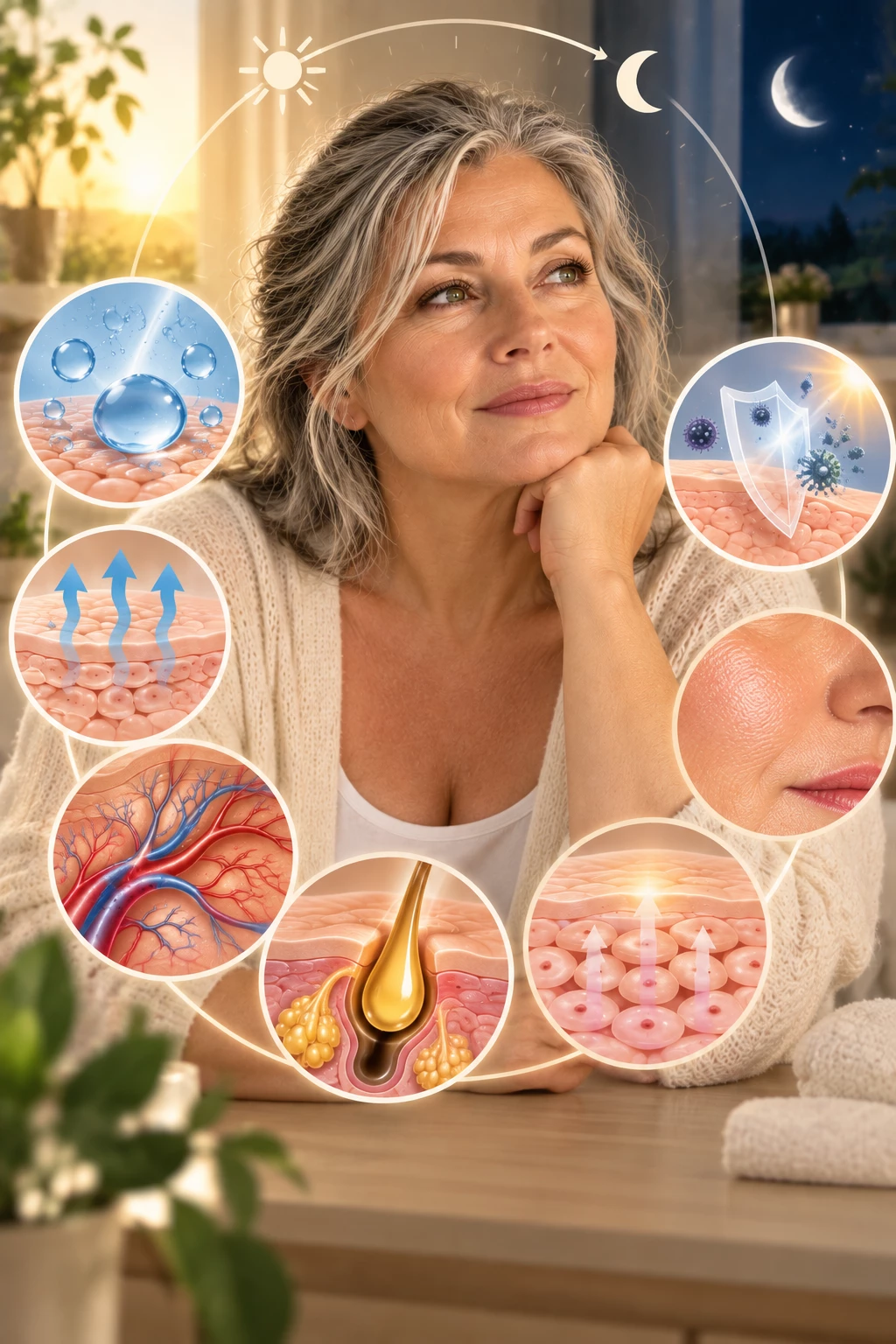
This means that several skin functions can vary depending on the time of day.
Hydration.
Water loss through the skin.
Cutaneous blood circulation.
Sebum production.
The proliferation and differentiation of certain epidermal cells.
The response to certain forms of stress.
Even some visible characteristics of the skin can vary throughout the day.
The skin is therefore not a completely static system.
It has its own rhythm.
But this rhythm is integrated into a much larger system.
The skin has a peripheral biological clock, but it remains in dialogue with the body's central clock and with its environment.
Why would the skin need a clock?
The answer is actually quite logical.
Your environment changes throughout the day.
The light changes.
The temperature changes.
Humidity can change.

You move more at certain times.
At other times, you sleep.
You are exposed to ultraviolet radiation during the day.
Your diet and meal times also change certain biological signals.
Your skin is directly exposed to many of these variations.
It therefore needs to be able to adapt.
A biological clock allows certain cellular functions to be coordinated over time.
It is one way for the body not simply to react when something happens.
It can also anticipate certain predictable conditions.
The circadian rhythm does not mean that everything happens at exactly the same time every day. It is an approximate temporal organization, influenced by the environment and by the body's state.
Your skin does not have the same job during the day and at night
During the day, your skin is confronted with its environment.
It receives light.
It experiences changes in temperature.
It encounters friction.
It is exposed to pollution, microorganisms, and ultraviolet radiation.
It must maintain an effective barrier while remaining flexible enough to allow you to move and sense your environment.
At night, conditions change.
You are generally less exposed to ultraviolet radiation.
Your body temperature changes.
Your physical activity decreases.
And your body enters a different physiological state.
The skin obviously does not stop functioning.
But some of its functions may follow a different rhythm.
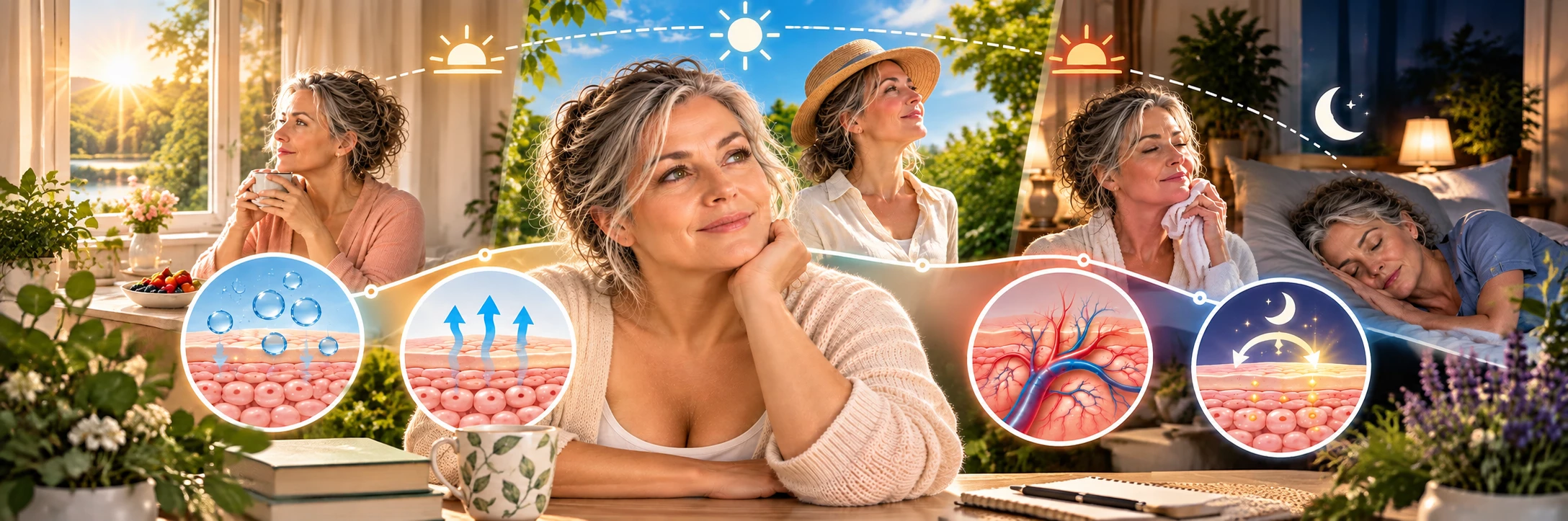
Research on skin rhythms has shown daily variations in hydration, transepidermal water loss, cutaneous blood flow, and several other parameters.
This does not mean that the skin suddenly becomes "night skin."
It rather means that some biological functions are modulated by the time of day.
The skin works twenty-four hours a day, but some of its functions change rhythm as the hours pass.
In the evening, the skin may become more permeable to water
Here is a particularly interesting example.
Water loss through the skin, known as insensible water loss or transepidermal water loss, is not perfectly constant throughout the day.
Circadian variations have been observed.
In some studies, skin-barrier permeability appears to be greater in the evening and during the night.
This does not mean that your skin "leaks" while you sleep.
It simply means that barrier function also has a temporal dimension.
And this dimension matters because the skin barrier must constantly find a balance between two requirements.
Retaining water.
And allowing certain exchanges with the outside.
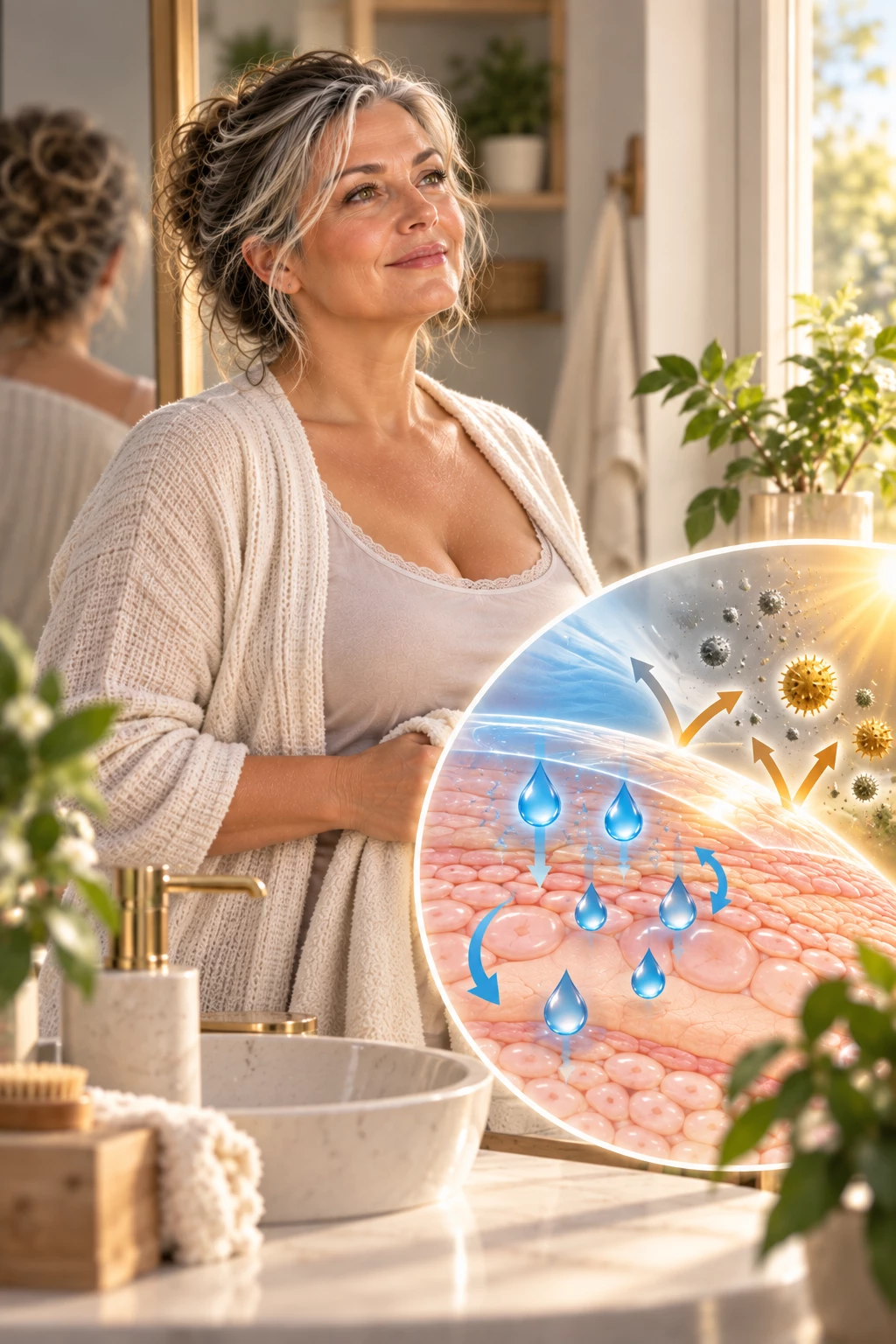
This variation is also not independent of age.
Aging changes several characteristics of the skin barrier, including its hydration, lipids, acidity, and certain recovery functions.
In other words, the skin's biological clock does not operate in a frozen organism.
It changes with us.
Circadian skin rhythms are well documented, but their exact expression can vary depending on the person, the body area, and the experimental conditions.
And what about light?
This is where the story becomes particularly interesting.
Light is one of the main signals used by our body to synchronize its circadian clock.
The brain receives light information through the eyes, among other pathways, and uses these signals to organize the sleep-wake cycle.
But the skin also has cells capable of responding to certain environmental signals.
This does not mean that the skin "sees" like your eyes.
It means that it is part of an organism whose biological rhythms are strongly influenced by the light-dark cycle.
And light is not always beneficial or always harmful.
It all depends on the type of light, its intensity, the duration of exposure, and the context.
Natural light accompanies our circadian rhythm.
Ultraviolet radiation, on the other hand, represents an important biological stressor for the skin.
So a common confusion should be avoided:
The fact that light can participate in synchronizing our biological rhythms absolutely does not mean that deliberate UV exposure is a good way to "set" your skin's biological clock.
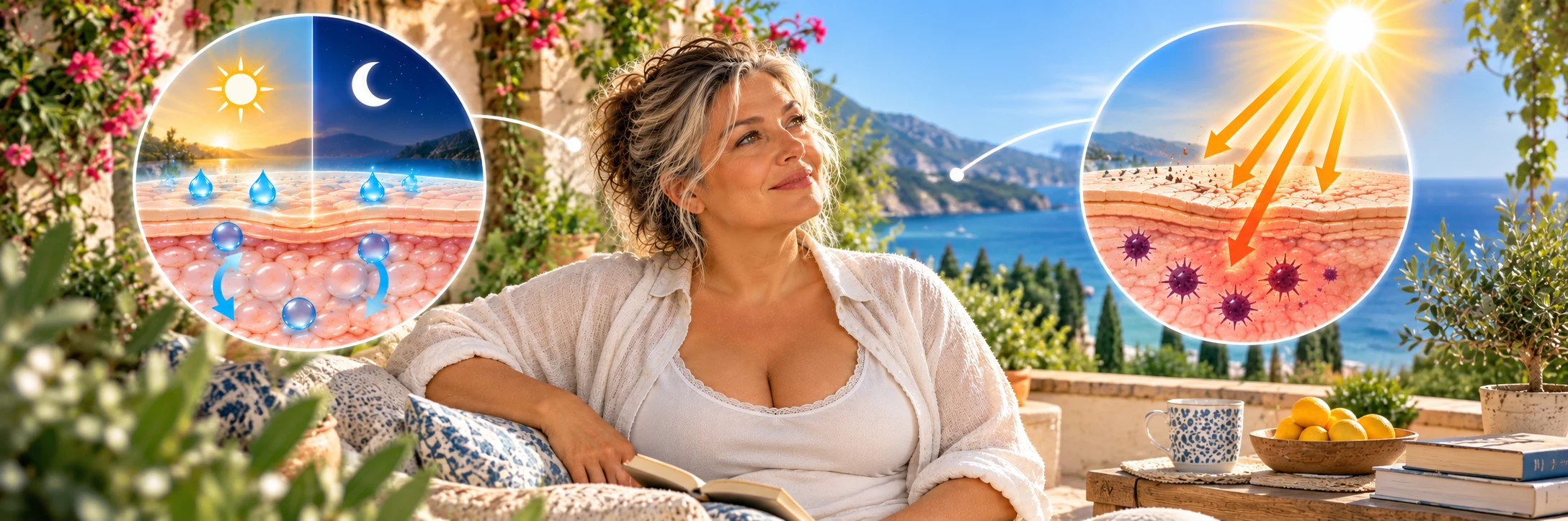
UV radiation can cause cellular damage and contribute to skin aging.
The biological clock and the effects of UV radiation are therefore two subjects linked to light, but they must absolutely not be confused.
Your skin also has its own rhythm of repair
The skin must constantly repair small forms of damage.
Some are obvious.
A cut.
An irritation.
Friction.
Others are much more subtle.
The skin barrier can undergo small disruptions throughout the day.
Cells can become damaged.
Inflammatory signals can be triggered.
The tissue must then maintain or restore its balance.
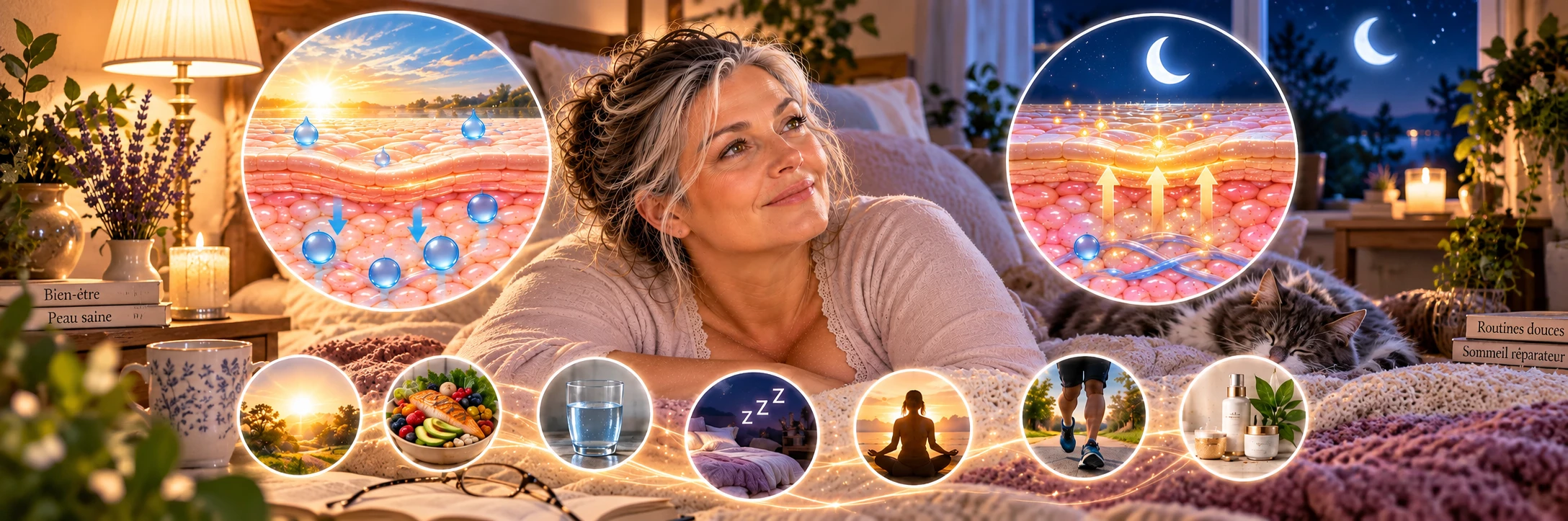
Experimental research shows that circadian clocks participate in regulating processes involved in skin repair.
But here again, we should avoid oversimplification.
We cannot reduce this to:
"The skin repairs itself at night."
That would be far too categorical.
Tissue repair is a complex process that depends on many factors.
Sleep.
Age.
Overall health.
Nutrition.
Hormones.
Inflammation.
The nature and extent of the damage.
And, among other mechanisms, biological rhythms.
Night is not a switch that turns your skin into a repair workshop. It is part of a different physiological environment in which certain biological processes are modulated.
And with age, what happens to this clock?
This is a particularly interesting question.
Aging does not necessarily mean that the skin's circadian clock disappears.
But some mechanisms related to circadian rhythms and their expression can change with age.
And above all, aging already changes the overall functioning of the skin.
The barrier may become less effective.
Hydration may decrease.
The lipid composition of the stratum corneum changes.
Recovery after certain forms of damage may be slower.
The production of certain molecules and the activity of certain cells also change.

The biological clock should therefore be understood as one element within an aging system.
It is not "the cause" of skin aging.
Skin aging is multifactorial.
It involves, among other things, the passage of time, ultraviolet radiation, cellular and molecular changes, inflammation, oxidative stress, and many other factors.
But understanding biological rhythms adds an interesting piece to the puzzle.
Studies on skin circadian clocks are promising, but many of the detailed mechanisms still come from experimental research. We should avoid turning them into universal cosmetic rules.
So, do you need to change your entire routine according to the time of day?
Not necessarily.
This is probably the most important conclusion of this article.
The fact that the skin has biological rhythms does not mean that you need to apply a different product every hour of the day.
Nor does it mean that a cream used at 10 p.m. magically becomes more effective than at 9:30 p.m.
Research into circadian rhythms opens interesting avenues, particularly for understanding how certain skin functions may vary over time.
But between a biological discovery and a universal practical rule, there is a big difference.
What we can take away is much simpler.
Your skin lives in time.
It does not react exactly the same way at every hour.
It receives signals from the environment.
It has internal synchronization mechanisms.
And these mechanisms interact with your age, your sleep, your environment, and your overall state.
Understanding the skin's clock is therefore not about finding the perfect time to apply a cream. It is about understanding that skin is living tissue that changes over time.
Your skin is not only alive. It has rhythms.
We began the previous article with a simple idea:
Your skin is an organ.
Today, we can go a little further.
Your skin is a living organ with rhythms.
It changes as the hours pass.
It interacts with light.
It responds to the environment.
It adapts some of its functions.
It maintains its barrier.
It participates in tissue repair.
And it does all of this within an organism that is itself governed by a biological clock.
That gives another dimension to what you see in the mirror.
Your skin is not a motionless surface.
It changes.
It works.
It adapts.
And it lives in time.
The next time you look at your skin in the morning, and then again in the evening, remember one thing:
You are not looking at exactly the same skin.
You are looking at the same organ, but at two different moments in its daily history.
And that difference, however subtle it may be, is part of what makes skin fascinating.
MEDICAL DISCLAIMER: SZ provides general information for educational purposes. It does not replace the advice, diagnosis, or treatment of a qualified healthcare professional. SZ does not diagnose, treat, cure, or prevent disease. For health-related decisions, consult a qualified professional.
Disclosure: Some links may be partner links. SZ may receive a commission from Canadian companies on qualifying purchases, at no extra cost to you and without influence on our editorial content.