
Can Your Skin Run Low on Fuel? When Skincare Isn't Enough

You've changed your moisturizer. Added a serum. Maybe you've even adopted a much more complete routine than before.
And yet, your skin still looks dull.
It lacks radiance, looks tired, its texture is less even and small imperfections keep coming back. Some days, it even seems to have lost something: its suppleness, its freshness, that little lively quality it used to have.
What's confusing is that you are taking care of it.
So why doesn't your skin show it?

Your Skin Doesn't Live on What You Apply to It Alone
A moisturizer can hydrate the surface. A serum can deliver certain active ingredients. A cleanser can remove what has built up on the skin during the day.
But your skin is living tissue.
It renews itself, produces proteins, maintains its protective barrier, manages its water balance and continually defends itself against the stresses it encounters.
To do all that, its cells need resources.
These resources come in part from what your body absorbs and uses every day: water, proteins, fatty acids, vitamins, minerals and other nutrients.
This doesn't mean that one particular food will suddenly transform your skin. It simply means that products applied to the skin are only part of the equation.
And that's where things get interesting.

When Your Skin Seems to Be "Missing Something"
There is no little red warning light that says: "your skin is lacking nutrients."
Reality is much less dramatic.
You may simply notice that your skin isn't functioning as well as it used to.
It looks less radiant. It doesn't recover as easily after irritation. Some areas become drier while others become shinier. Imperfections seem to linger. The texture appears less even.
Taken individually, none of these signs can tell you exactly what is happening.
But when they persist over time, they may lead you to look at your routine differently.
Not just what you put on your face.
But also what your body receives to keep all of its tissues functioning properly.
The Paradox of the Perfect Routine
This is one of the reasons some routines end up becoming endless.
A problem appears: new serum.
Your skin feels tight: new cream.
Imperfections come back: new cleanser.
Your complexion lacks radiance: new active ingredient.
And when the result still isn't what you hoped for, you end up looking for the next product.
Yet multiplying skincare products doesn't necessarily solve a question whose answer lies somewhere else.
Imagine a plant.
You can clean its leaves, mist them with water and place them in a beautiful pot. But if its roots don't have what they need, caring for the leaves won't be enough to solve the problem.
The comparison has its limits, but it helps explain one essential thing: the surface doesn't tell the whole story.
Your Skin Keeps Working Even When You're Not Thinking About It

While you sleep, your skin doesn't go on pause.
Its cells continue their normal activities. Some are replaced, certain proteins are produced, the skin barrier is maintained and the effects of daily stressors are gradually dealt with.
All of this requires energy and building materials.
That's why nutrition shouldn't be considered only in terms of weight, calories or body shape.
It also provides the elements your body needs to function.
And your skin is part of that body.
This helps explain why a period of poor nutrition, very unbalanced meals or simply insufficient intake can sometimes coincide with skin that seems less healthy.
It is not proof that a deficiency is causing your skin problem.
It is rather a reason not to look at the skin as something completely separate from the rest of the body.
The Important Word: Balance
It would be tempting to go too far and conclude that every dull complexion is a "poorly nourished" complexion.
That would be just as simplistic as believing that a cream can fix everything.
The appearance of the skin depends on many factors: genetics, age, hormones, sleep, stress, sun exposure, environment, skincare routine, diet and many others.
Nutrition is therefore one piece of the puzzle, not the whole puzzle.
And that is precisely why it deserves a little more attention.

Before Looking for a Supplement, Look at Your Plate
If your skin seems tired, the first question isn't necessarily:
"What supplement should I buy?"
It can be much simpler:
Is my diet regularly providing what my body needs?
The basics remain surprisingly unglamorous: enough protein, a variety of foods, fruits and vegetables, sources of healthy fats, adequate hydration and a diet diverse enough to meet your micronutrient needs.
It's not spectacular.
But that's precisely what makes the question interesting.
Because a supplement doesn't turn an overall unbalanced diet into a complete one.
It can have a place when intake is insufficient or a particular need exists, but it does not replace dietary variety.
Two Small Minerals We Hear a Lot About
Among the micronutrients that are of particular interest to the skin, two names come up often:
magnesium and zinc.
They do not have the same role and should certainly not be presented as two miracle ingredients.
Magnesium participates in numerous reactions essential to the normal functioning of cells.
Zinc contributes, among other things, to the maintenance of normal skin and to various processes involved in tissue renewal and repair.
In other words, they are not interesting because they would be hidden “beauty products.”
They are interesting because the skin needs an organism that is functioning properly.
And this is exactly where the distinction becomes important: understanding the role of a nutrient does not mean that taking more of it will necessarily be better.
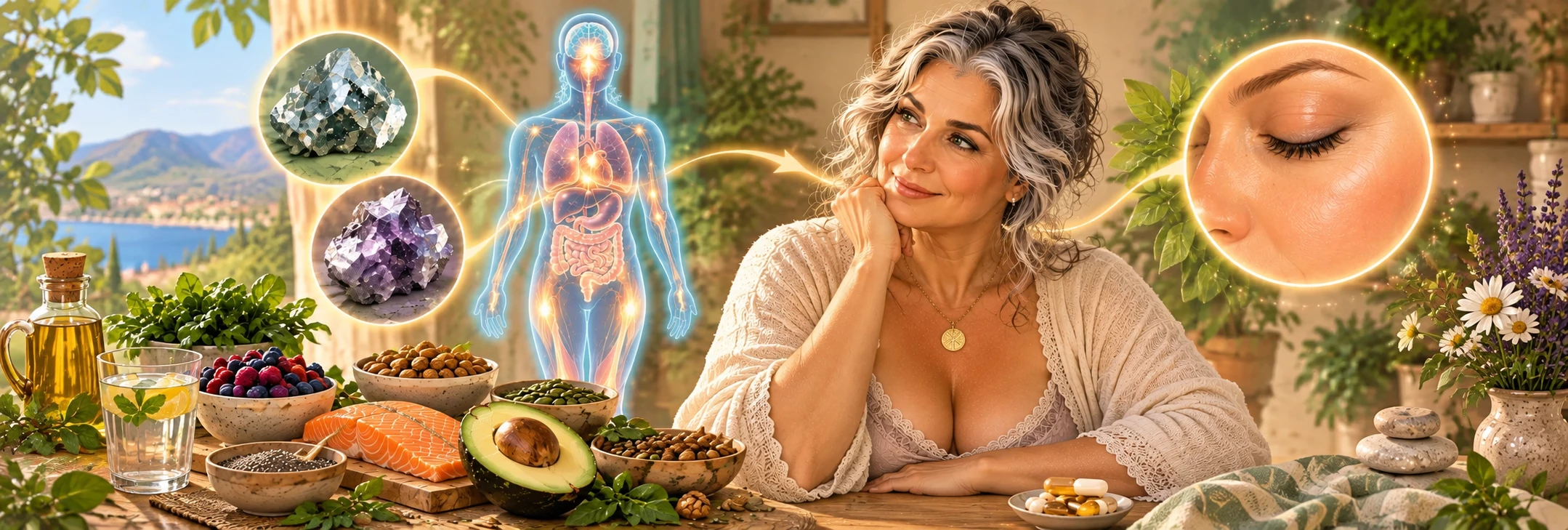
"Hungry" Skin Isn't Necessarily Deficient Skin
This is probably the most important point to remember.
Dull or blemish-prone skin does not automatically mean that you are lacking magnesium, zinc or another substance.
There are too many possible causes to draw such a conclusion from a mirror.
On the other hand, if your skin seems to have lost its balance despite a reasonable routine, it may be useful to consider the overall environment in which it functions.
Your sleep.
Your diet.
Your stress level.
Your sun exposure.
Your daily habits.
Your skincare routine.
And, when relevant, your nutritional intake.
Your skin is not an independent façade. It is part of you.
And Now, Magnesium
Magnesium deserves a closer look because it is involved in a considerable number of the body's normal functions.
But its relevance to the skin cannot be reduced to a promise like "take magnesium and you'll have younger-looking skin."
The real question is much more interesting: what does magnesium actually do in the body, and why might that have something to do with the way your skin functions?
That's what we'll take a closer look at in another article on the subject.
Your skin is more than what you see in the mirror.
Its appearance also depends on what is happening inside the body that keeps it alive.
MEDICAL DISCLAIMER: SZ provides general information for educational purposes. It does not replace the advice, diagnosis, or treatment of a qualified healthcare professional. SZ does not diagnose, treat, cure, or prevent disease. For health-related decisions, consult a qualified professional.
Disclosure: Some links may be partner links. SZ may receive a commission from Canadian companies on qualifying purchases, at no extra cost to you and without influence on our editorial content.